
Catalog › Measurement and control › Solenoid coils
Solenoid Valve Coils: 12/24 V DC and 110/220 V AC Replacement Coils
Replacement coils for hydraulic and pneumatic solenoid valves: 12 and 24 V DC, 110 and 220 V AC; bore sizes from Ø9 to 31.6 mm, NG06 and NG10 valve coils.
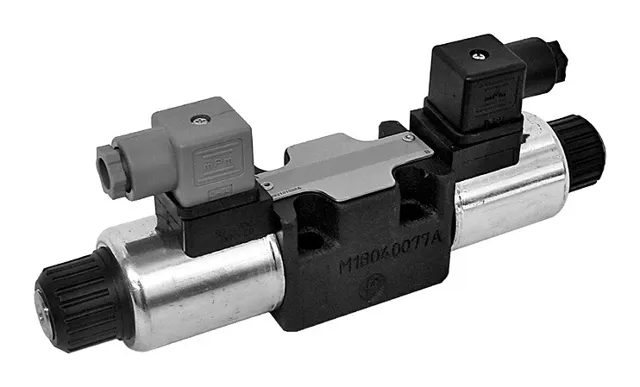
A solenoid valve consists of two parts: the body that directs the oil or air, and the electromagnet — the coil — that moves the spool inside it. The coil is the part of the valve that talks to the electrical system, and it is the part that fails most often. That is why it is sold separately: the body may be sound while the coil has burnt out, or a machine may have been moved to a different supply voltage so that only the coil needs changing.
Ordering a replacement coil calls for three pieces of information. First, voltage and current type: 12 V DC and 24 V DC on mobile machinery and PLC-controlled circuits, 110 V AC and 220 V AC in fixed industrial plant. Fitting a coil of the wrong voltage burns it out in seconds; putting 220 V on a 24 V coil is the most common and most expensive of these mistakes.
Second, the diameter and height of the bore that sits over the valve pin. Stock covers Ø9, Ø10, 13, 14.85, 16, 21.1, 23.2, 26.2 and 31.6 mm. This dimension is printed in the product name in millimetres and governs fit regardless of brand — coils of the same size from different makers will usually interchange. On modular hydraulic valves the size is quoted by valve size directly: NG06 (Cetop 3) valves take 23.2 mm class coils, NG10 (Cetop 5) valves take the 31.6 mm class.
Third, power and protection rating. AC coils are rated in VA, DC coils in W (18 VA, 28 W and so on). Coils rated IP65 withstand dust and water jets; that rating should be insisted on outdoors and on machines that are washed down. Connector type should also be stated when ordering; some coils come with an LED connector fitted.
The two most common causes of a burnt coil are a spool jammed by dirt in the body, and a supply voltage that runs persistently high. When the spool sticks, the coil converts the load it cannot move into heat and the winding cooks. For that reason, when coils burn one after another the culprit is usually not the coil but a valve body that needs cleaning.
Brands and series
Pemaks 2 products
Luen 1 products
Series pages are in Turkish; product codes are the same in every language.
Other products (brand not specified)
125 products in our price lists with no brand or no code stated, sorted by name (in Turkish). Pages: 1.
Brands and standards in stock
Frequently asked questions
How do I determine coil size?
What matters is the diameter of the bore that fits over the valve pin, and the coil height; both appear in the product name in millimetres (14.85 mm or 23.2 mm, for instance). Remove the old coil and take those two measurements with calipers, and a compatible coil can be found regardless of brand.
What do NG06 and NG10 mean?
NG06 and NG10 are mounting-interface standards for modular hydraulic valves (also known as Cetop 3 and Cetop 5). The coils for these valve sizes are standardised in turn: 23.2 mm class for NG06, 31.6 mm class for NG10. The information is printed on the valve label.
My coils keep burning out — why?
When coils fail one after another the problem is usually in the valve body, not the coil. A spool jammed by dirt or by particles in the oil cannot move under the coil's magnetic field; the coil turns the load it cannot shift into heat and the winding cooks. Fitting a new coil without cleaning the body gives the same result. The second cause is a supply voltage persistently above the coil rating.
Can a 220 V coil replace a 24 V coil?
No. Voltage and current type (DC/AC) must match the coil label exactly. A coil of the wrong voltage either will not pull in at all or burns out within seconds. Because the same body is produced with coils in several voltages, a coil fitting physically does not mean it fits electrically.
Why does the IP65 rating matter?
IP65 means the coil is dust-tight and withstands water jets from any direction. That rating should be required on machines working outdoors and in food and textile plants that are washed down with pressurised water. Inside a dry enclosure, a lower rating is adequate.
Get a quote for Solenoid coils
Send us the size and quantity you need and our sales team will get back to you the same day with pricing and lead time. If you're not sure of the size, a photo of the part you have is enough.
More in Measurement and control
 Pressure gauges and vacuum gauges2,188 products
 Pressure switches and pressure transmitters69 products
 Thermometers, thermostats and temperature sensors186 products
 Level gauges and level switches443 productsFlow measurement and control230 products
 Gauge isolator valves and pressure test equipment63 products