
Catalog › Technical guides › Hose selection
Hydraulic Hose Selection: What 1SN, 2SN, 2SC, 4SP and 4SH Mean
How to determine hose class, bore and length; how braid count changes pressure rating, and why bend radius decides service life.
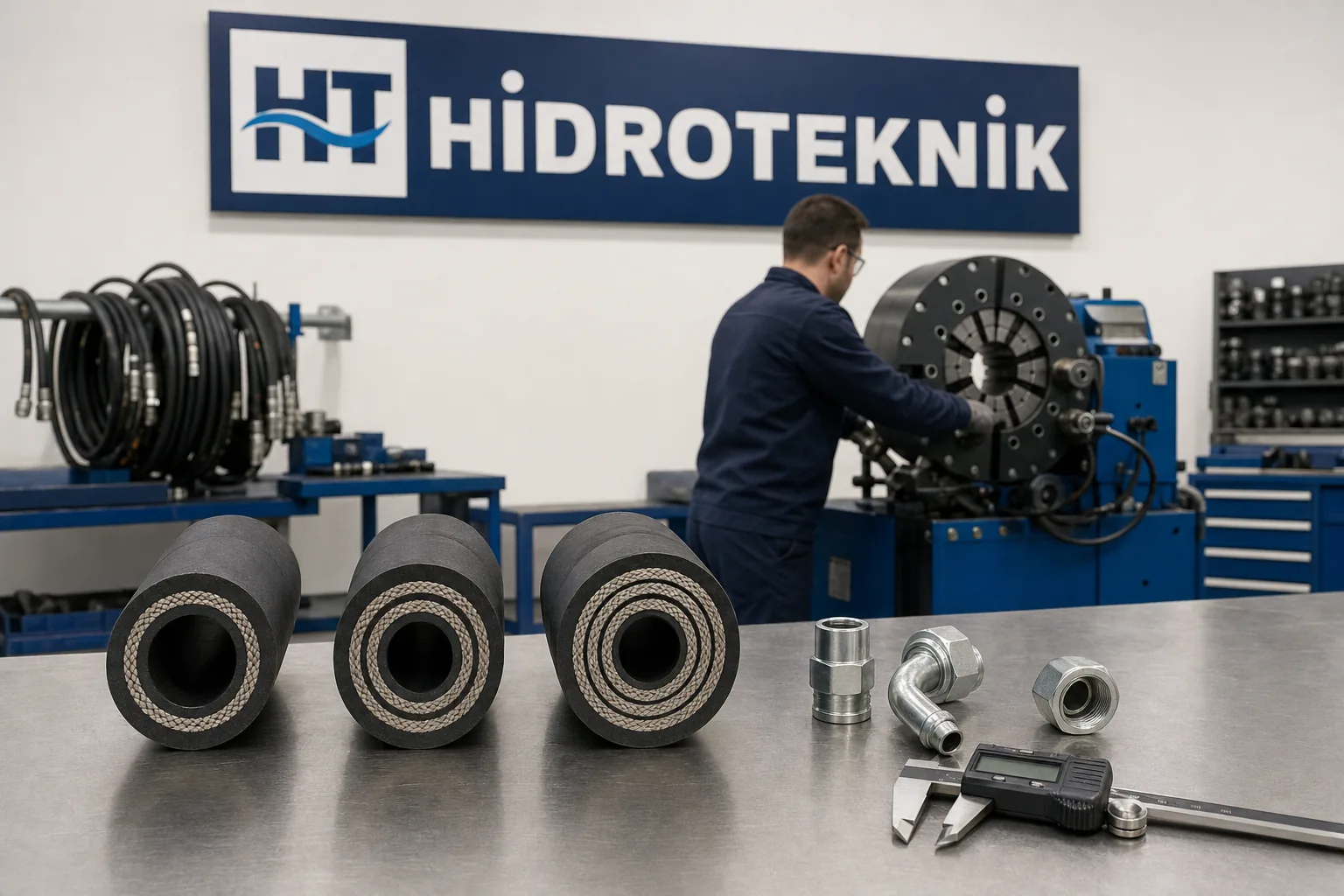
A hydraulic hose is ordered with three pieces of information: bore, reinforcement class and length. If one of them is missing the hose cannot be made up; if one is wrong, the hose either will not work or bursts early.
The bore is given in inches (1/4", 3/8", 1/2", 5/8", 3/4", 1") and is read from the print on the hose. It determines the flow the hose will pass. An undersized hose throttles the flow, heats the oil and slows the system; an oversized one takes up unnecessary space and is harder to route.
The reinforcement class gives the pressure rating and is read from the code letters. Classes beginning with R describe braided hose: R1 and 1SN have a single steel braid, R2 and 2SN have two. Classes with an SC suffix (2SC, for instance) are also double-braid but with a more compact outer diameter — they carry the same pressure in less space, which is why they are preferred in tight installations. 4SP and 4SH are four-spiral hoses; they are the highest pressure class and are used on construction machinery, presses and heavy-duty applications. R6 is single-braid and low pressure, suitable for lines that carry no pressure such as return.
The more layers of reinforcement, the stiffer the hose. This directly affects bend radius: a 4SH hose cannot be bent as tightly as a 2SN. Any installation that goes below the minimum bend radius in the catalogue strains the inner reinforcement and shortens hose life. A significant share of hoses that fail in the field die not from pressure but from a sharp bend.
Length is measured centre of fitting to centre of fitting, with a small allowance because hose shortens under pressure. As a rule, allow about 2–4% extra length. A hose installed taut pulls on the fitting once pressurised; one left too slack chafes against its surroundings with vibration.
Finally, the hose class and the socket class must match: crimping a 1SN socket onto 2SN hose will not hold. Crimping is done on our own premises, and made-up hoses in standard sizes are usually delivered the same day.
Frequently asked questions
What is the difference between 2SN and 2SC?
Both are double steel braid and in a similar pressure class. The difference is the outside diameter: 2SC has a thinner cover and a more compact construction, so it routes more easily in tight installations and bends to a slightly smaller radius. At the same bore, choosing 2SC makes assembly noticeably easier on machines where space is short.
Where do I read the hose bore?
The bore is printed on the hose cover, usually in both inches and DN (1/2" DN12, for example). If the print has worn away, cut the hose and measure the bore with calipers. Going by outside diameter is misleading — hoses of the same bore vary in outside diameter with braid count and class.
Can 4SH replace 2SN anywhere?
In terms of pressure yes, but in practice it often is not suitable. 4SH is four-spiral, considerably stiffer, and its minimum bend radius is markedly larger. Fitting 4SH to a route designed for 2SN forces the hose below its acceptable radius and shortens its life. It also adds unnecessary cost and weight.
How is hose length measured?
Length is measured from the centre of one fitting to the centre of the other. Because hose shortens somewhat under pressure, allow about 2–4% extra. A hose fitted taut pulls on the fitting when pressurised and strains the joint; one left far too long sags and abrades against its surroundings.
When should a hose be replaced?
Replace immediately if the braid shows through the cover, if the hose has ballooned, if there is a leak at the base of the fitting, or if the hose has hardened and lost flexibility. Even without visible damage, hard-working systems are put on a replacement interval; the cost of a burst hose is not the hose but the machine standing idle.
Can R6 hose be used on a pressure line?
It should not be. R6 is single-braid and low pressure; it suits tank return, drain and similar unpressurised lines. Fitted to a pressure line, R6 hose bursts within a short time once the system reaches full pressure.
Related product groups
Get a quote for Hose selection
Send us the size and quantity you need and our sales team will get back to you the same day with pricing and lead time. If you're not sure of the size, a photo of the part you have is enough.