
Catalog › Technical guides › Cylinder leaks
Why Is My Hydraulic Cylinder Leaking? Seven Causes of Seal Failure
Why a replaced seal leaks again months later: rod scoring, misalignment, assembly damage, wrong material, excessive temperature and dirty oil.
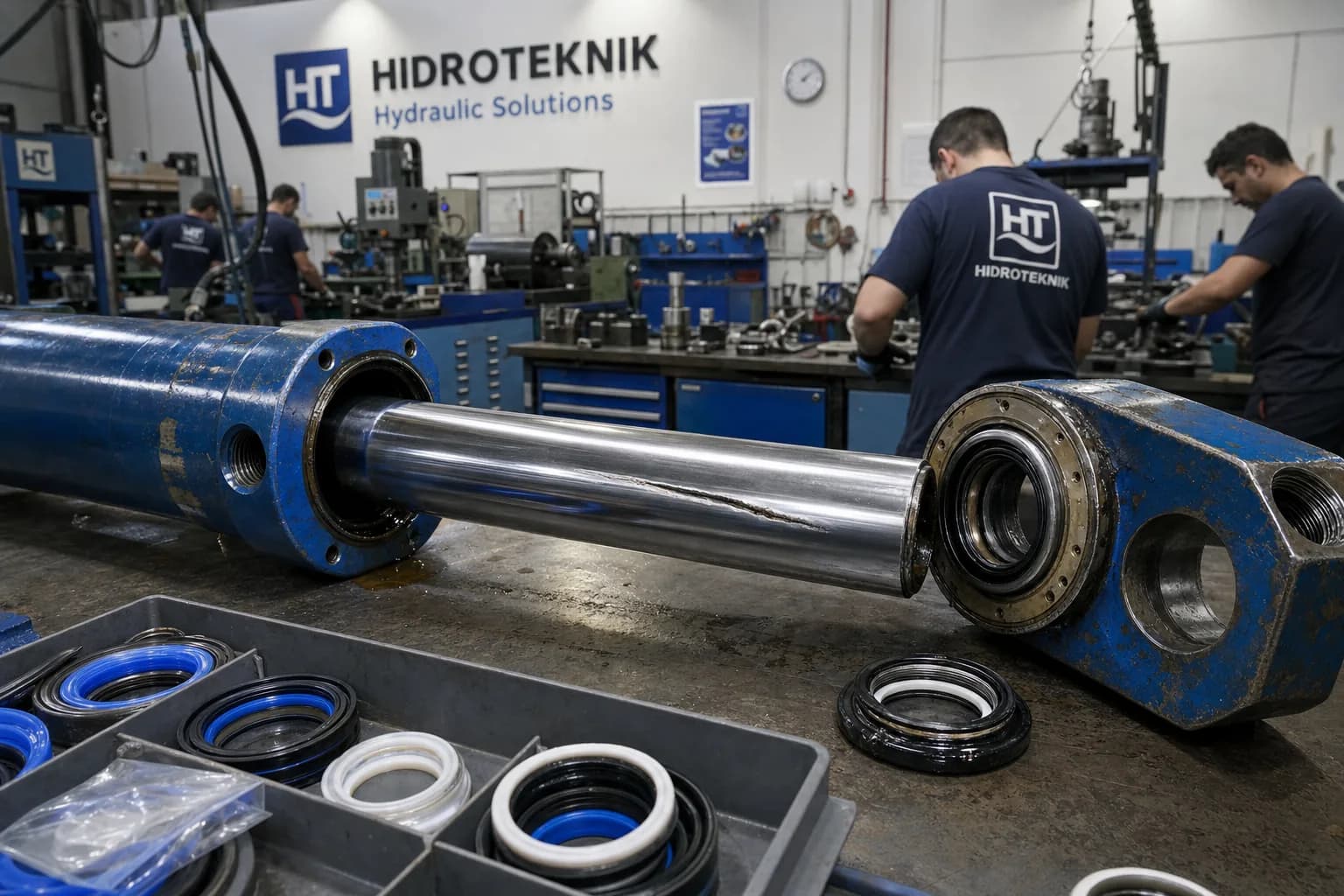
The first reflex with a leaking cylinder is to change the seal, and most of the time it works. But if the seal leaks again a few months later, the problem is not the seal — the seal is only the symptom of another fault. Repeat leaks in the field come down to these seven causes.
The first is the rod surface. A deep score running along the axis forms a channel that continuously passes oil under the seal lip; no seal can close it. Where chrome plating is flaking, the fragments cut the new seal on its first stroke. Shallow marks that cannot be felt with a fingernail are harmless; if they can be felt, the rod must be renewed.
The second is misalignment. If the cylinder is not on the same axis as the load, the rod takes a side load; the seal is pressed harder on one side, wears there and starts leaking from that side first. A leak concentrated on one face of the rod is the classic sign. The remedy is not a seal but a rod end — the cylinder has to be allowed to swing with the load.
The third is assembly damage. The seal is cut as it passes the thread at the rod end or the corner of the gland; the damage can be too small to see, but the leak starts immediately. Seals should be lubricated and fitted with an assembly sleeve, and sharp corners taped over.
The fourth is worn bearings. The guide rings (K68, K69 and the like) hold the rod centred. As they wear, the rod develops play and loads the seal sideways on every stroke. Checking the wear rings while the seals are changed is the single most effective step against repeat leaks.
The fifth is material choice. A standard NBR seal works up to roughly 100 °C. In systems that run hotter continuously the seal hardens, loses elasticity and its lip pressure falls. FKM (Viton) should be used instead. If a water-based fluid is in use, the material has to be selected separately for it.
The sixth is temperature, and it goes with the fifth: if the oil sits above 60 °C continuously, both seal and oil age quickly. Here the answer is not a seal but a cooler.
The seventh is dirty oil. Metal particles in the oil score the rod surface like abrasive and eat the seal lip. In a system whose filter is clogged or running in bypass, seal life is short. If leaks keep recurring, the filter and the condition of the oil should be checked too.
Frequently asked questions
I replaced the seal and it still leaks. Why?
The cause is most likely not the seal itself. The two most common reasons are a score running along the rod and a seal cut during assembly. A third common cause is a worn guide ring — with the rod off centre, the new seal is quickly worn on one side as well. Rod surface and wear rings must always be checked when seals are changed.
The leak always comes from the same side of the rod — what does that mean?
That is the classic sign of misalignment. If the cylinder does not work in line with the load, the rod takes a side load, the seal is pressed harder on one side and wears there. The remedy is not a better seal but a rod end that lets the cylinder swing, together with a correction of the mounting geometry.
How much scoring on a rod is acceptable?
The practical test is your fingernail: any mark your nail catches on as you run it along the rod is deep enough to pass oil under the seal lip, and the rod should be renewed. Shallow marks the nail does not catch are harmless. Circumferential marks (across the rod axis) are far less damaging than longitudinal ones.
When should I use FKM instead of NBR?
FKM (Viton) is needed where oil temperature is continuously above 100 °C, or where there is contact with fuel or chemicals. NBR hardens under those conditions and its lip pressure falls. Conversely, for water-based fluids neither NBR nor FKM is automatically the best choice; the material has to be selected for the fluid.
Should I buy a seal kit or a single seal?
If the cylinder is already stripped, a kit is almost always right: the labour has already been spent, and leaving the other aged elements in place means doing the same job again a few months later. Replacing a single seal only makes sense for external seals that can be reached without stripping the cylinder.
The cylinder does not leak externally but is weak — why?
That is internal leakage: the piston seal is passing oil from one side of the piston to the other. No oil comes out, but the cylinder cannot lift the load, or drifts back slowly under load. To confirm, hold the cylinder fully extended and apply pressure; if the rod creeps back, the piston seal is passing.
The cylinder will not hold a load in the air — is the seal to blame?
Not always. If the load descends slowly there are two possibilities: the piston seal is passing, or a valve in the circuit is leaking internally. To tell them apart, close off the cylinder's lines; if the load still descends the fault is inside the cylinder, if it stops the fault is in the valve. Applications that require safety should also use a load-holding valve.
Related product groups
Get a quote for Cylinder leaks
Send us the size and quantity you need and our sales team will get back to you the same day with pricing and lead time. If you're not sure of the size, a photo of the part you have is enough.