
Catalog › Technical guides › Pressure gauge selection
Pressure Gauge Selection: Range, Dial Size, Connection and Glycerine
A gauge with the wrong range is either unreadable or dies quickly. How to pick the range against working pressure, what glycerine filling does, and the difference between bottom and back connection.
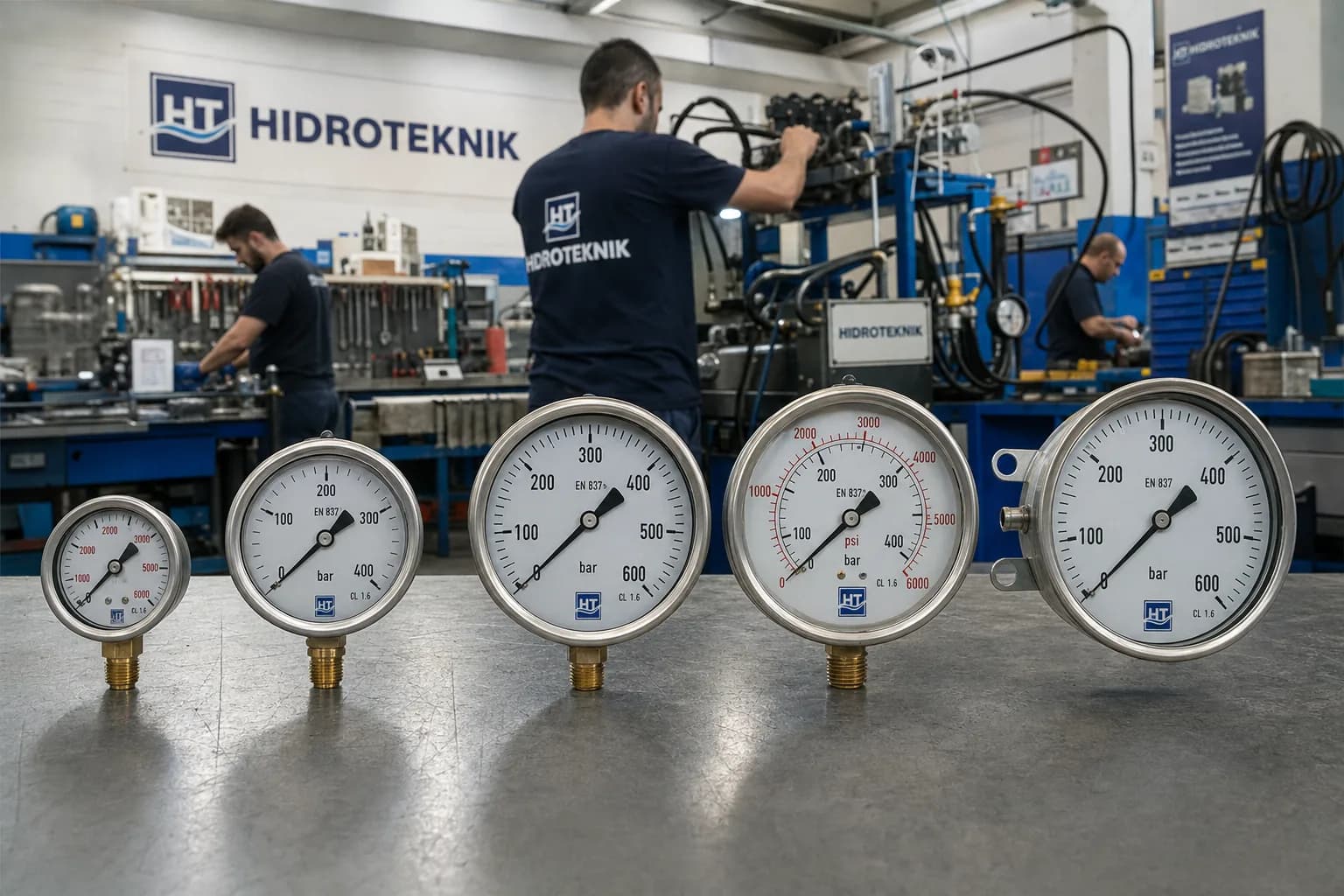
The most common mistake in gauge selection is buying the range closest to system pressure. Fitting a 0-250 bar gauge to a circuit running at 200 bar looks sensible but is wrong, and it wears the instrument out fast.
The rule: normal working pressure should be read in the middle of the scale. Under steady load it should not exceed about three quarters of full scale, and under fluctuating load about two thirds. For a circuit running at 200 bar the right choice is 0-400 bar: the pointer sits around twelve o'clock, pressure spikes stay inside the scale, and the movement is not permanently strained at its limit. In a gauge working at the very top of its scale the Bourdon tube deforms permanently, and in time the pointer stops returning to zero.
There is an opposite mistake too: buying 0-1000 bar for 200 bar. Now the pointer stays in the first fifth of the scale, a 10 bar change cannot be distinguished by eye, and the gauge stops being an instrument.
Dial diameter is directly related to readability. Ø40 fits tight spaces but cannot be read from a distance; Ø63 is the most common balance; Ø100 is used in panels and where fine adjustment is needed. A larger dial also means a better accuracy class, because the graduations do not become crowded.
Glycerine filling exists for vibration and pulsation. At a pump outlet, near a valve block, and on mobile machinery the pointer vibrates constantly; it is both unreadable and the geared movement wears. Glycerine damps that vibration and markedly extends instrument life. On a steady line it is unnecessary — a dry gauge is enough and cheaper. At very low temperature glycerine thickens and slows the pointer; at very high temperature the filling expands.
Connection orientation follows the mounting: bottom (radial) connection stands upright on the line, back (axial) connection is for flush mounting in a panel face. Thread size is usually 1/4" or 1/2" BSP; when connecting a gauge, confirm the thread type together with the fitting side.
Frequently asked questions
What gauge range should I buy for a 200 bar system?
0-400 bar. The general rule is that normal working pressure should fall between half and two thirds of full scale. Buying 0-250 bar for 200 bar keeps the pointer permanently at the top of the scale and deforms the Bourdon tube; 0-600 bar makes changes unreadable.
Should I buy glycerine-filled or dry?
Glycerine-filled if there is vibration or pulsation. Pump outlets, the area near a valve block and mobile machinery all fall into that class; there a dry gauge vibrates too much to read and the movement wears within months. On a steady tank or test line a dry gauge is adequate and cheaper.
My gauge does not return to zero — can it be repaired?
In practice no, it is replaced. Failing to return to zero shows the Bourdon tube is permanently deformed, and that is irreversible. The cause is usually a range chosen too tight, or a pressure shock. When buying a replacement, move the range up one step or the same result repeats.
What is the difference between bottom and back connection?
Only the mounting direction; the measurement is identical. Bottom (radial) connection stands upright on the line and is the most common. Back (axial) connection is for flush mounting in a panel or cover face, usually together with a clamp or flange. Available space decides which you take.
Does dial diameter affect measurement accuracy?
Indirectly, yes. On a larger dial the same pressure range is spread over a longer arc, graduations stay open and reading error falls; this is why Ø100 gauges are typically found in a better accuracy class. Ø40 is practical for tight spaces but not suitable for fine adjustment.
Can I fit a gauge directly to the pump outlet?
You can, but choose a glycerine-filled type and if possible use a throttle or a gauge isolator cock. The pump outlet is where the sharpest pulsation in the system occurs; a throttle softens the shock and extends instrument life. A cock also lets you change the gauge without draining the system.
I need to measure low pressure — will the same gauge do?
No. Pressures of a few bar or in the mbar region need a diaphragm-type instrument; a Bourdon tube gauge produces no meaningful movement in that range. Pneumatic lines and low-pressure circuits use diaphragm types with an mbar scale.
Related product groups
Get a quote for Pressure gauge selection
Send us the size and quantity you need and our sales team will get back to you the same day with pricing and lead time. If you're not sure of the size, a photo of the part you have is enough.