
Catalog › Technical guides › Fitting thread types
Hydraulic Fitting Threads: How to Tell BSP, BSPT, Metric, JIC and ORFS Apart
Metric, BSP, BSPT, JIC and ORFS threads look alike but are not interchangeable. How to identify them in five minutes with calipers and a thread gauge.
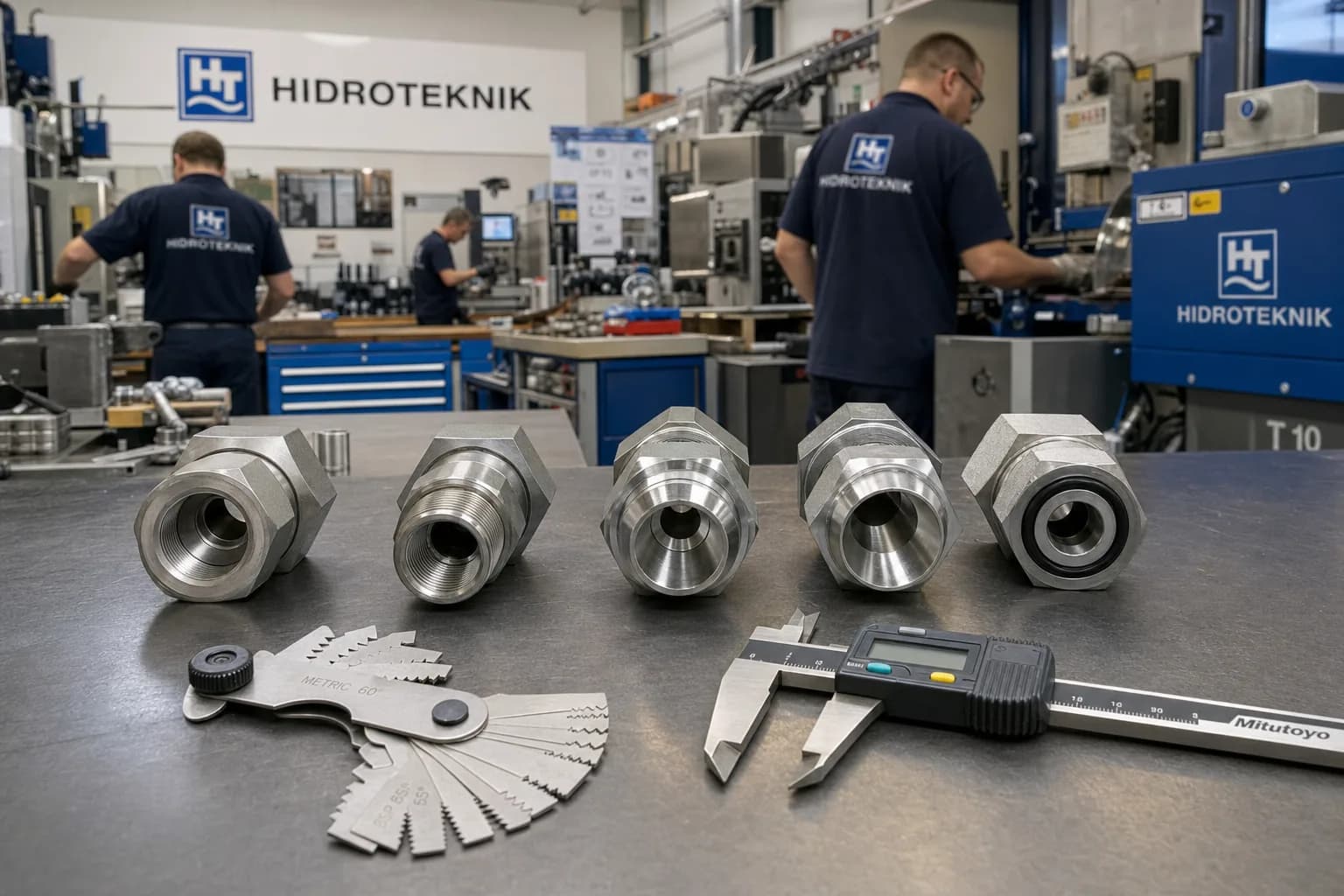
The most common mistake in hydraulics is not choosing the wrong product but fitting the wrong thread because it looked right. Metric, BSP, BSPT, JIC and ORFS threads resemble each other to the naked eye; two of them will turn together by hand for a few turns, then bind, and the joint looks made up. When the system is pressurised, the connection either weeps or blows off.
Three things are measured to tell them apart: the thread's outside diameter, its pitch, and where the sealing takes place. The first two need calipers and a thread gauge; the third can be seen by eye.
The sealing point gives the quickest distinction. Parallel-thread connections (BSP, metric, ORFS) do not seal on the thread — sealing is done either by an O-ring at the root of the thread or by a coned face; the thread only does the clamping. Tapered connections (BSPT, NPT) seal on the thread itself, which is why the diameter changes along its length and why it tightens further the harder it is turned. A tapered thread needs tape or liquid sealant; a parallel one does not — wrapping tape on a parallel thread does not fix a leak, it only makes disassembly harder.
BSP and metric are separated by pitch. BSP pitch is given as threads per inch (1/4" BSP = 19 TPI); metric pitch is given in millimetres (M18 × 1.5). A thread gauge distinguishes the two scales. As a rough check, BSP thread crests are more rounded than metric ones, but that alone should not be relied on.
JIC and ORFS are separated by the sealing face. A JIC connection seals on a 37° cone, metal to metal, with no O-ring. ORFS has a flat face and seals with an O-ring sitting in a groove in that face. Even at the same thread size the two cannot be substituted: a JIC cone will not seat on an ORFS flat face.
One more confusion with BSP: the name of the thread is not its outside diameter. A 1/4" BSP thread measures about 13.16 mm across, not 1/4 inch (6.35 mm). Taking the measured diameter for the thread designation accounts for a significant share of ordering errors.
When in doubt, the safest route is to measure the part in hand and send a photograph with it: the thread outside diameter, the pitch and a photo of the sealing face are enough to identify the correct equivalent.
Frequently asked questions
What is the difference between BSP and BSPT?
Both use the same thread form and pitch; the difference is the taper. BSP is parallel — the diameter is constant along the thread and sealing is by O-ring or coned face. BSPT is tapered — the diameter narrows along the thread and sealing happens on the thread itself, which is why it needs tape or liquid sealant. A male BSPT can be screwed into a female BSP port, but the joint is not safe.
How do I tell metric from BSP?
Look at the pitch. Metric pitch is in millimetres (M18 × 1.5 means a 1.5 mm pitch), BSP pitch is in threads per inch (19, 14, 11 TPI). A thread gauge separates the two definitively. Without one, counting the threads over a 25 mm length gives a usable approximation.
Should I wrap PTFE tape on a parallel thread?
No. On a parallel thread (BSP, metric, ORFS) the seal is made by an O-ring or a coned seating face, not by the thread. Tape does not cure a leak; it only prevents the nut being tightened to the correct torque and makes disassembly difficult. If a parallel thread leaks, check the O-ring or the seating face.
Are JIC and ORFS interchangeable at the same size?
They are not. JIC seals metal to metal on a 37° cone; ORFS seals with an O-ring in its flat face. Even where the thread sizes overlap, the seating geometries differ; a JIC cone will not seat on an ORFS flat face and the joint will leak. If a transition is needed, use a JIC-to-ORFS adaptor.
Why is a 1/4" BSP thread not 6.35 mm across?
The inch figure in a BSP designation does not give the thread's outside diameter; historically it refers to the nominal bore of the pipe the connection was used with. The actual outside diameter of a 1/4" BSP thread is about 13.16 mm. Taking the measured diameter for the thread designation is a frequent mistake.
I cannot measure the thread — what should I send?
Two photographs, one from the side and one of the sealing face, together with the thread outside diameter taken with calipers. The face photo shows whether there is an O-ring groove (ORFS or JIC); the side photo shows whether the thread is parallel or tapered. Those three are enough to identify the correct equivalent.
Related product groups
Get a quote for Fitting thread types
Send us the size and quantity you need and our sales team will get back to you the same day with pricing and lead time. If you're not sure of the size, a photo of the part you have is enough.