
Catalog › Technical guides › Hydraulic motor selection
Orbital Hydraulic Motor Selection: Displacement, Speed and Torque
Displacement sets speed and torque at the same time, and raising one lowers the other. Speed from flow, torque from pressure, and the most common mistake in selection.
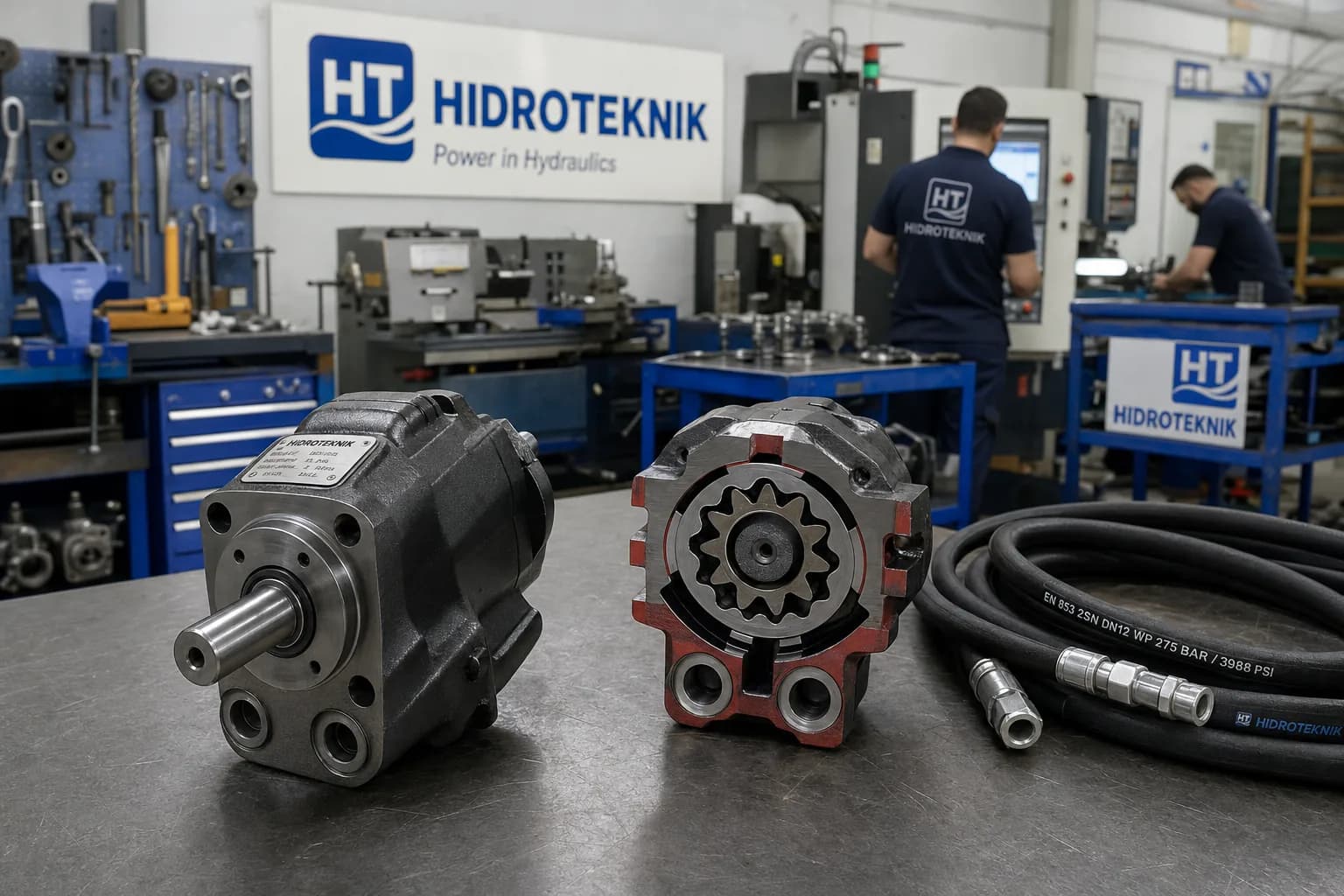
Selecting an orbital hydraulic motor rests on a single number: displacement, the volume of oil the motor takes in one revolution (cm³/rev). Both speed and torque follow from it, and they move in opposite directions — increasing displacement raises torque and lowers speed.
Speed is flow divided by displacement:
n (rpm) = Q (L/min) × 1000 / V (cm³/rev)
A pump delivering 40 L/min turns a 200 cm³/rev motor at 200 rpm. Fit a 400 cm³/rev motor to the same pump and speed halves to 100 rpm.
Torque comes from pressure difference multiplied by displacement:
M (Nm) = Δp (bar) × V (cm³/rev) / (20 × π)
That is M ≈ Δp × V / 62.8. On the same 200 cm³/rev motor, a 150 bar pressure difference gives roughly 478 Nm. Raise displacement to 400 cm³/rev and torque doubles to 955 Nm — but speed had already halved. The power taken from the motor does not change; only its split between speed and torque does.
Both formulas are theoretical. In reality volumetric and mechanical efficiency intervene; in practical calculation taking about 90% of the torque and again about 90% of the speed gives a result closer to reality. In orbital motors running at low speed the loss share increases.
The most common mistake in selection is reversing the order: picking a motor first and then looking for a pump. It is the other way round — the torque and speed the job needs are known, displacement is calculated from them, and the required flow and pressure are written as requirements on the pump and the circuit. The return line must not be forgotten either: an orbital motor's drain line must run directly to tank without restriction, to keep pressure off the shaft seal.
Frequently asked questions
If I increase displacement, does the motor get more powerful?
It gives more torque but turns more slowly; the power taken from the motor stays the same. Power is torque multiplied by speed, and that product depends on flow and pressure. If you want more power you must raise flow or pressure, not displacement.
I have a 40 L/min pump — what speed will I get?
Divide by displacement: n = 40 × 1000 / V. A 200 cm³/rev motor gives 200 rpm, a 100 cm³/rev motor 400 rpm, a 400 cm³/rev motor 100 rpm. In practice volumetric efficiency means you get about 90% of that figure.
Which pressure do I use in the torque calculation?
Not system pressure, but the DIFFERENCE between motor inlet and outlet. If there is back pressure in the return line, the effective difference shrinks and torque falls below what you expected. In a system with a blocked return filter this is often exactly why the motor feels weak.
What is the difference between an orbital and a piston motor?
An orbital (gerotor) motor gives high torque at low speed, is compact and inexpensive; it is the typical choice for mixers, conveyors, winches, agricultural and cleaning machinery. An axial piston motor offers higher efficiency and higher speed, costs more, and is generally used in higher-power applications.
Must the drain line go to tank?
On types with a drain port, yes, and it must run directly to tank without restriction. If back pressure builds in the drain line, the shaft seal has to carry it and begins to leak. Connecting the drain into the return line means the return pressure lands on the seal.
The motor stalls under load but spins freely — why?
Usually the pressure difference is insufficient: either the pump is not producing the required pressure, or a relief valve is set too low. The second possibility is internal leakage in the motor — a worn orbital set spins freely but passes oil internally under load and cannot deliver torque. Measuring pressure at the motor inlet separates the two.
Can I run the same motor in reverse?
Most orbital motors are bidirectional; swapping the lines reverses rotation. The point to watch is the drain and return line: when direction changes, so does which line is under pressure, so make sure the return line is unrestricted in both directions.
Related product groups
Get a quote for Hydraulic motor selection
Send us the size and quantity you need and our sales team will get back to you the same day with pricing and lead time. If you're not sure of the size, a photo of the part you have is enough.