
Catalog › Technical guides › Cylinder calculations
Hydraulic Cylinder Calculations: Force, Speed and Flow
Working out push and pull force from bore, rod diameter and pressure; speed from flow; and pump and motor power from both.
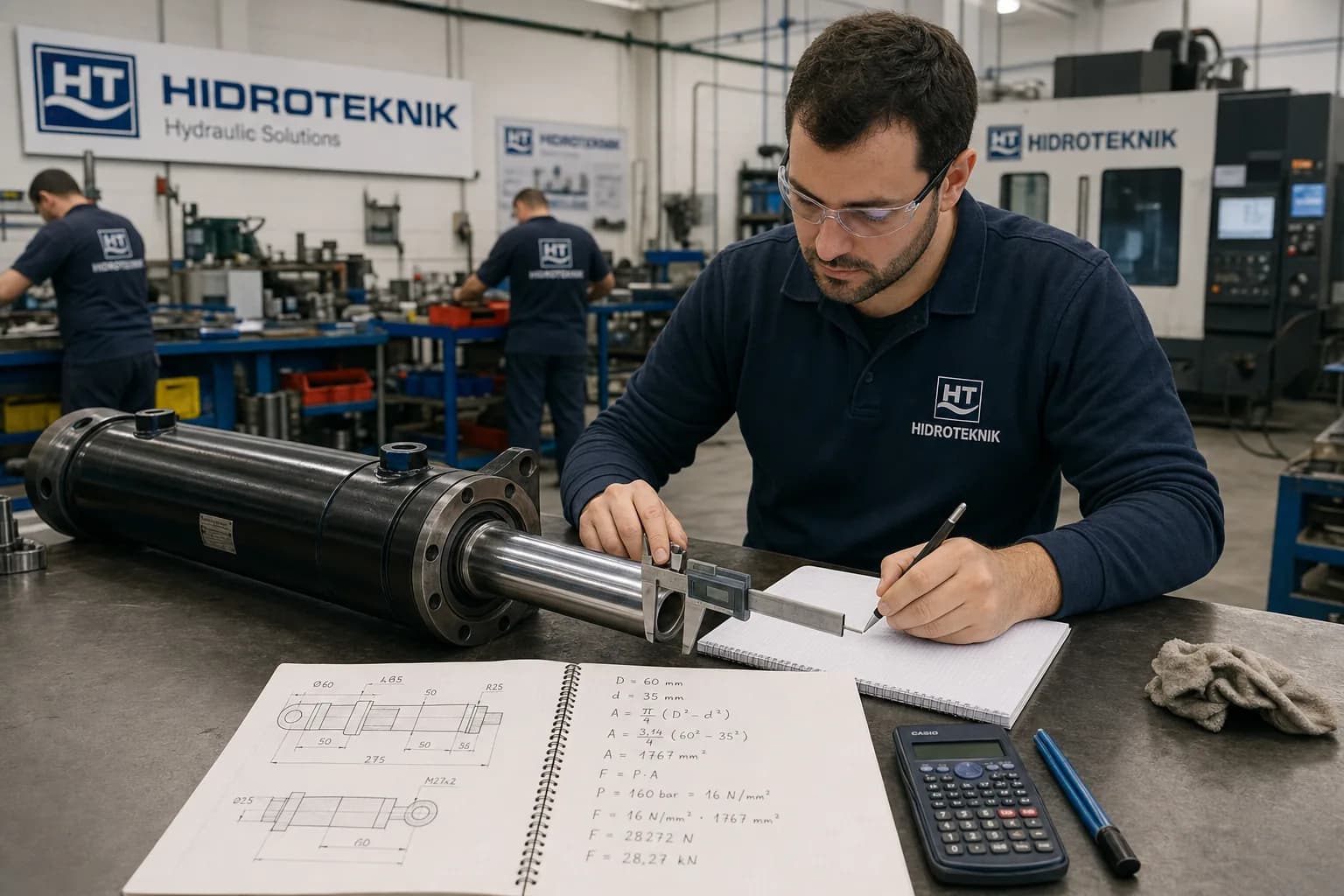
How much force a hydraulic cylinder will give, how fast it will move, and how much pump is needed to do it are found with three simple formulas. All three rest on the same two dimensions: the bore (barrel inside diameter) and the rod diameter.
Force is pressure multiplied by area. On extension, oil acts on the full face of the piston, so the area comes from the bore: F = P × π × D² / 4. In practical units: force (kgf) ≈ pressure (bar) × piston area (cm²). A cylinder with an 80 mm bore has an area of 50.3 cm²; at 150 bar it gives about 7,540 kgf, that is 7.5 tonnes of push.
On retraction, the area taken up by the rod is out of play. Pull force is therefore always lower than push force: the area is the piston area minus the rod area. On a cylinder with an 80 mm bore and a 45 mm rod, the annulus area is 50.3 − 15.9 = 34.4 cm²; at the same 150 bar, pull force is about 5,160 kgf. Whether the load works against the cylinder on the push or the pull stroke is therefore decisive in design.
Speed comes from flow: v = Q / A. In practical units: speed (cm/s) ≈ flow (l/min) × 16.67 / area (cm²). Feeding 20 l/min into an 80 mm cylinder gives an extension speed of about 6.6 cm/s. At the same flow, retraction is faster because there is less volume to fill — that is why a double-acting cylinder returns faster than it extends.
Pump flow is worked backwards from the speed wanted: required flow (l/min) = area (cm²) × speed (cm/s) / 16.67. Motor power then comes from pressure and flow: power (kW) ≈ pressure (bar) × flow (l/min) / 600. That formula includes an approximate allowance for overall efficiency; the next standard motor size above the result is chosen.
Finally, do not skip the buckling check. Cylinders with a long stroke and a slender rod can buckle in the push direction even when the force calculation is satisfied. As stroke grows, rod diameter has to grow with it; the rod diameter–stroke tables in the catalogue give this limit.
Frequently asked questions
Why are push and pull force different?
On extension, oil acts on the full face of the piston. On retraction, the area occupied by the rod is lost, because the rod already fills that volume. With a smaller effective area, pull force at the same pressure is lower. The difference grows as rod diameter increases.
How do I make the cylinder faster?
Speed is directly proportional to flow, so the first route is to increase pump flow. The second is a smaller bore cylinder — but that reduces force as well. If speed is wanted without giving up force, a higher-flow pump and a matching motor are needed, and the line and valve sizes must be increased to carry the new flow.
What pressure should I design for?
Raising pressure lets the same force be produced by a smaller cylinder, saving space and cost. But higher pressure also raises the class of hose, fittings and seals required, and increases internal leakage. In industrial applications 150–210 bar is a typical range; mobile hydraulics uses higher figures.
How do I choose the rod diameter?
There are two constraints. The first is pull force: a thicker rod reduces the annulus area and therefore the pull force. The second is buckling: on long-stroke cylinders a slender rod can bend in the push direction. In long-stroke applications, rod diameter is sized from the buckling table, not from the force calculation.
The cylinder is not giving full force — what could it be?
First measure system pressure with a gauge: if the relief valve is set low or opens early, pressure never builds. If pressure is correct, the piston seal inside the cylinder may be passing — when oil crosses from one side of the piston to the other, force drops but the cylinder still moves. This usually calls for a seal kit replacement.
How do I measure the bore?
The bore is the inside diameter of the cylinder barrel and equals the inside dimension of the honed tube. If the cylinder is not stripped, it can be worked out from the barrel outside diameter and wall thickness; where the label is legible, it is printed there. The size is normally a standard step such as 40, 50, 63, 70, 80, 90 or 100 mm.
Related product groups
Get a quote for Cylinder calculations
Send us the size and quantity you need and our sales team will get back to you the same day with pricing and lead time. If you're not sure of the size, a photo of the part you have is enough.